Best Puppy Food for Great Pyrenees Puppies
General nutrition information compiled from product labels and published sources, not veterinary advice. Your veterinarian is the right person to choose a diet for your dog, especially one with a health condition.
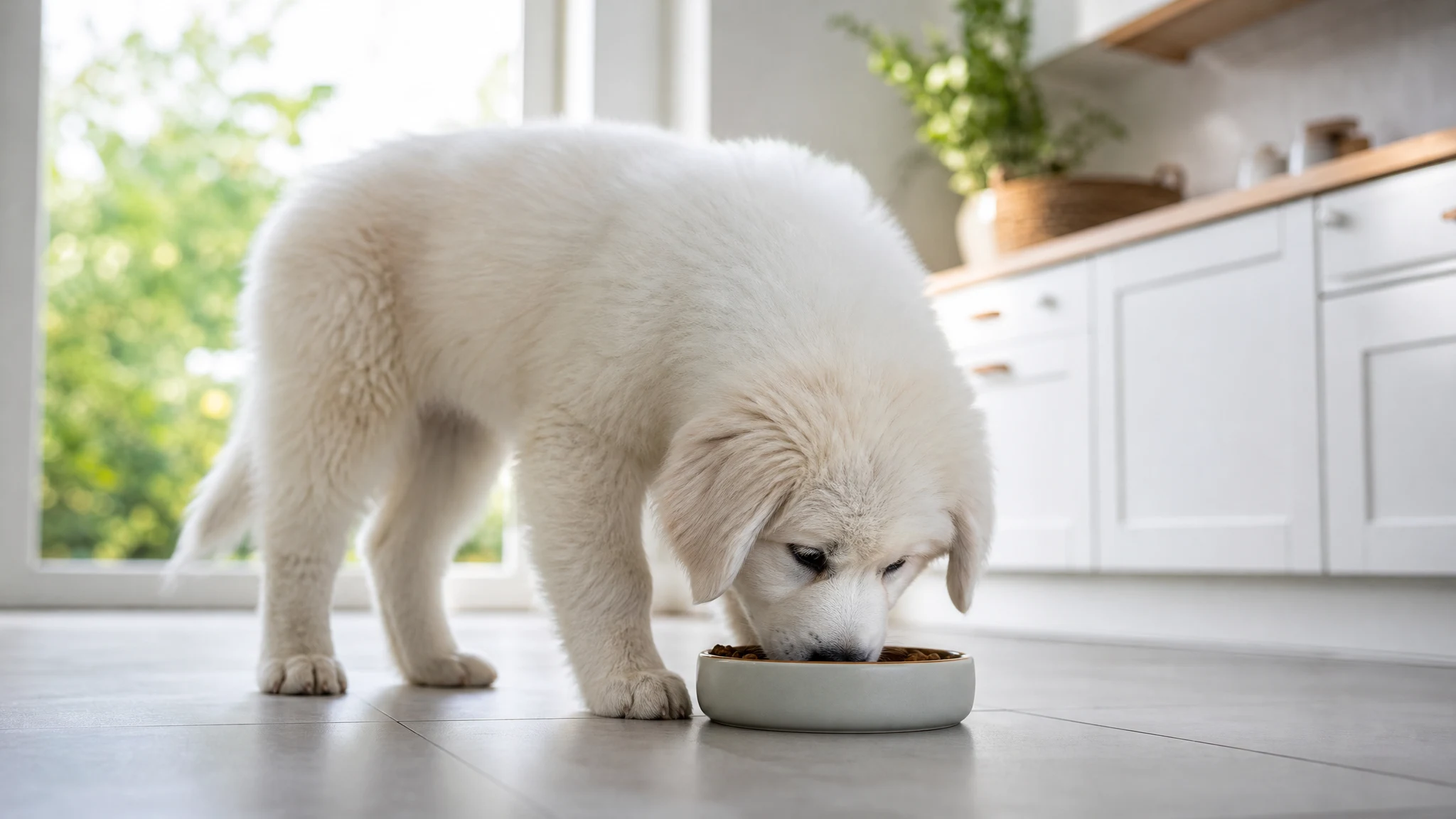
A Great Pyrenees puppy grows fast and ends up big. Hill's Pet lists adult weight at 85 to 120 pounds, with males heavier. The Westminster Kennel Club puts the breed in the large size category. That adult size should drive how you read a bag, a can or a fresh-food pack.
This guide covers what to look for on a label, which features matter most, four puppy foods whose label data we compared, and the red flags worth knowing. It also covers where to buy and when to move to adult food. It is not a ranking of tastes or results, and it is not medical advice.
How we compared these foods
We compared label data published on each brand's own product page: AAFCO statement, first ingredients, guaranteed analysis, calories and life stage. We did not run feeding trials or taste tests, and we did not feed any of these foods to dogs. A label tells you what a company says is in the food. It does not tell you how your puppy will do on it.
We left prices out on purpose. The brand pages we compared do not give a price that applies everywhere, and prices change. Check the brand for current pricing.
Why a Great Pyrenees puppy needs a different kind of food
Hill's Pet says Great Pyrenees puppies need large-breed nutrition until at least 18 months. It adds that full adult size can take up to two years. It also says the calcium and phosphorus ratio matters for bone development. PetMD says the breed generally does well on food formulated for large breeds, and that diet is a topic for your veterinarian.
Hill's also notes that hip and elbow dysplasia can occur in large-breed dogs, and that controlled growth and moderate exercise support joints. PetMD describes these conditions as hereditary, with exercise, weight and nutrition able to influence them. No food prevents or treats them. A veterinarian decides what is right for an individual puppy.
What to look for on the label
1. The AAFCO statement
This is the first thing to find. The statement says which life stage the food is formulated for. For a puppy, you want growth or all life stages.
According to Dog Food Advisor's summary of the AAFCO nutrient profiles, growth and all-life-stages foods must say whether they include or exclude growth of large-size dogs, meaning dogs that reach 70 pounds or more as adults. A Great Pyrenees falls in that class. So look for wording such as "including growth of large-size dogs." A food that says it excludes large-size growth is the wrong match, even if the bag shows a big dog on the front.
Several of the product pages we looked at show only part of the statement. If you cannot find the large-size wording, read the full statement on the package or ask the brand before you buy.
2. A large-breed or giant-breed puppy formula
Hill's, Royal Canin and VICTOR each offer a puppy food aimed at large or giant dogs. A food built for a Chihuahua puppy is a poor fit for a dog that will weigh well over 80 pounds. Size-specific formulas are one clear quality signal, though they still need the AAFCO check above.
3. The first ingredients
Ingredients are listed by weight before cooking. Look for a named protein near the top, such as chicken or chicken meal. "Chicken by-product meal" is a legal, named ingredient. It reads differently to many owners, so decide for yourself whether it matters to you. A long list is not a sign of quality, and marketing words on the front of a bag are not a substitute for the statement on the back.
4. The guaranteed analysis
This panel gives minimum protein and fat and maximum fiber and moisture. Compare foods of the same type against each other. A dry food and a fresh food hold very different amounts of water, so their numbers cannot be lined up directly.
5. Calories per cup
Calories tell you how much of a food a puppy will eat to meet energy needs. A food with more calories per cup needs a smaller portion. Use calories to compare cost per day, not to judge quality.
6. A feeding guide you can follow
Good labels give amounts by weight or age. Treat these as starting points. Your veterinarian can adjust them based on your puppy's body condition and growth.
Key features to compare
- Large-size growth wording: present, absent, or not shown on the product page.
- Adult weight range the food targets: Royal Canin's giant puppy food is for dogs over 100 pounds as adults. Hill's large-breed puppy food is for dogs over 55 pounds as adults.
- Protein and fat minimums: compare within the same food type.
- Calories per cup: affects portion size and bag life.
- Form: dry, wet or fresh. Each has handling, storage and cost differences.
- How long the puppy formula runs: Hill's lists its large-breed puppy food up to 18 months. Royal Canin lists its giant puppy food up to 8 months.
Great Pyrenees puppy food: four options compared
These are the foods from our research whose labels cover growth. We did not include adult-only foods, or a general puppy food that is not made for large breeds.
| Food | Form | AAFCO life stage | Protein min | Fat min | Fiber max | Calories per cup |
|---|---|---|---|---|---|---|
| Royal Canin Giant Puppy | Dry | Growth | 32% | 12% | 3.9% | 338 kcal ME (calculated) |
| Hill's Science Diet Puppy Large Breed Chicken & Brown Rice | Dry | Growth | Not stated as a minimum | Not stated as a minimum | Not stated as a maximum | 387 kcal |
| VICTOR Hi-Pro Plus Large Breed Puppy | Dry | All life stages | 30% | 14% | 6.0% | 365 kcal |
| Nom Nom Beef Mash | Fresh, shipped frozen | All life stages | 8% | 5% | 4% | 201 kcal (calculated) |
Hill's shows dry matter averages instead of guaranteed minimums on its page: 26.7% protein, 15.4% fat, 2.8% fiber and 1.16% calcium. Averages are not the same as legal minimums, so do not set them side by side with the other rows as if they were.
Giant breed pick: Royal Canin Giant Puppy
The Royal Canin Giant Puppy page describes a food for puppies expected to weigh over 100 pounds as adults, up to 8 months old. That fits the upper range of a Great Pyrenees, especially a male. The first five ingredients are chicken by-product meal, brewers rice, wheat gluten, brewers rice flour and corn. Royal Canin states the food is formulated to meet AAFCO nutritional levels for growth.
The full sentence on the page was not clear about large-size growth. Check the bag. The page does not give kibble size or a feeding table, only a calculator. Royal Canin's Giant Adult food is listed for dogs over 18 to 24 months old, but the page for the puppy food ends at 8 months. Ask the brand or your veterinarian how to handle the gap.
Large breed pick: Hill's Science Diet Puppy Large Breed
The Hill's Science Diet Puppy Large Breed Chicken & Brown Rice page lists the food for large-breed puppies over 55 pounds as adults, up to 18 months. That lines up with the 18-month figure Hill's gives on its Great Pyrenees breed page. The first five ingredients are chicken, brown rice, whole grain oats, chicken meal and cracked pearled barley. It has 387 kcal per cup.
Hill's says animal feeding tests using AAFCO procedures support the growth claim. Hill's gives a weight-based feeding chart by growth stage and tells owners to adjust amounts to maintain optimal weight. Again, confirm the large-size growth wording on the package.
Higher protein, all life stages: VICTOR Hi-Pro Plus Large Breed Puppy
The VICTOR Hi-Pro Plus Large Breed Puppy page lists an all life stages food with 30% minimum protein, 14% minimum fat and 6.0% maximum fiber. The first five ingredients are chicken, chicken meal, brown rice, whole grain millet and whole grain sorghum. It has 365 kcal per cup.
The page's AAFCO sentence continues past the part we could read. Check the full statement for the large-size wording. VICTOR publishes breed-specific feeding charts by age and weight. For adults over 100 pounds, it says to increase intake by half a cup for every 20 pounds over 100. That is a label guide for adults and a starting point only.
Fresh option: Nom Nom Beef Mash
The Nom Nom Beef Mash page says the recipe meets AAFCO nutrient levels for all life stages, including growth of large-size dogs of 70 pounds or more as adults. That is the clearest large-size wording among the foods here. The first five ingredients are ground beef, russet potatoes, eggs, carrots and peas. It has 201 kcal per cup, calculated.
Fresh food has more water than dry food, so the 8% protein and 5% fat minimums are not comparable with dry food numbers. Nom Nom points owners to its daily feeding guide. Check the brand for current pricing, shipping and storage needs, since this is a frozen product.
Which type fits your situation?
We do not have reliable price data, so we cannot rank these by cost. Here is a way to think about the choice instead:
- You want a giant-breed label: Royal Canin Giant Puppy is the one aimed at dogs over 100 pounds.
- You want a well-documented 18-month plan: Hill's Puppy Large Breed matches the 18-month guidance Hill's gives for the breed.
- You want one food from puppyhood through adulthood: VICTOR and Nom Nom use all life stages statements. Ask your veterinarian whether that suits a large puppy that you want to grow steadily.
- You want fresh food: Nom Nom is the fresh option here with clear large-size growth wording.
Dry food is usually simpler to store and measure. Fresh food adds convenience and cost questions. Both can meet the same AAFCO standard when the statement says so.
Feeding schedule and portions
Feed a puppy several times a day instead of one big meal. PetMD advises multiple small meals for the breed, and also advises avoiding vigorous exercise around mealtimes and avoiding raised bowls. Those tips come from PetMD's discussion of bloat, also called GDV. PetMD describes it as life-threatening, and says a gastropexy is often done to help prevent it. Talk with your veterinarian about the right meal schedule and whether a gastropexy makes sense for your dog.
Start with the amount on the label for your puppy's age or expected adult weight. Then adjust with your veterinarian based on body condition. Do not let a puppy get heavy, since Hill's links controlled growth to joint health. Weigh your puppy on a regular schedule and keep a record.
Red flags to avoid
- No AAFCO statement at all. Without it, you cannot tell whether the food is complete for growth.
- An adult maintenance statement on a puppy. Some fresh and adult foods are labeled for maintenance only. JustFoodForDogs, for example, says its Beef & Russet Potato recipe is not intended for growing puppies.
- A statement that excludes growth of large-size dogs. This is the wrong fit for a Great Pyrenees.
- A small-breed or general puppy formula. Hill's own puppy canned food is a general puppy food, not a large-breed formula, so we left it out of the comparison.
- Claims that a food prevents or cures a disease. No ordinary dog food can promise that. Be wary of any package that does.
- Heavy marketing with thin label detail. If calories, ingredients and the full AAFCO statement are hard to find, move on.
- Frequent food changes. Switch foods slowly, and ask your veterinarian how to do it for your puppy.
A note on grain-free and DCM
The FDA Center for Veterinary Medicine has investigated a possible link between certain diets and canine dilated cardiomyopathy. Its latest update on that page is dated December 23, 2022, and the FDA says it does not plan more public updates until there is meaningful new scientific information. None of the four puppy foods above is labeled grain-free. If you are weighing a grain-free or boutique diet, ask your veterinarian first and read the FDA page yourself.
When to switch to adult food
Hill's says large-breed puppy nutrition should continue until at least 18 months, and that full size can take up to two years. Do not switch at a calendar date alone. Ask your veterinarian to check your puppy's growth and condition first.
When the time comes, look for an adult food with maintenance wording suited to a large dog. Royal Canin's Giant Adult food is listed for dogs over 18 to 24 months. Hill's lists its Adult Large Breed food for dogs aged 1 to 5 years in the 55 to 110 pound range, and its giant range for dogs 110 pounds and up. Check these against your own dog's size.
Where to buy
Start with the brand's own page to confirm the formula, the AAFCO statement and the current package. Royal Canin, Hill's, VICTOR and Nom Nom each describe where their products are sold. Nom Nom sells direct and ships frozen. For the others, the brand pages are the place to start for store information.
Check that the bag is sealed and the date is current. Look at the formula name on the package, since brands sell many similar-looking foods. Buy a size you can use before it goes stale, and store dry food in a cool place in a tightly closed container.
The short version
For a Great Pyrenees puppy, choose a large-breed or giant-breed growth food, confirm the large-size wording on the label, and compare calories and feeding guides. Feed several small meals a day and plan to stay on puppy food until at least 18 months, with your veterinarian guiding the timing. Treat this guide as a way to read labels, not as a verdict on any one product.
Sources
- Hill's Pet: Great Pyrenees breed page
- PetMD: Great Pyrenees breed page
- Westminster Kennel Club: Great Pyrenees breed page
- Dog Food Advisor: AAFCO nutrient profiles
- FDA Center for Veterinary Medicine: Investigation into diets and canine dilated cardiomyopathy
- Royal Canin: Giant Puppy
- Hill's Pet: Science Diet Puppy Large Breed
- VICTOR Pet Food: Hi-Pro Plus Large Breed Puppy
- Nom Nom: Beef Mash