Wet vs Dry vs Fresh Food for Great Pyrenees
General nutrition information compiled from product labels and published sources, not veterinary advice. Your veterinarian is the right person to choose a diet for your dog, especially one with a health condition.
A Great Pyrenees is a large dog. Hill's Pet lists adults at 85 to 120 pounds, with males heavier. That size shapes the wet vs dry dog food question more than any trend does. Big dogs eat a lot, so calories per cup, cost over a month, and how you store the food all matter.
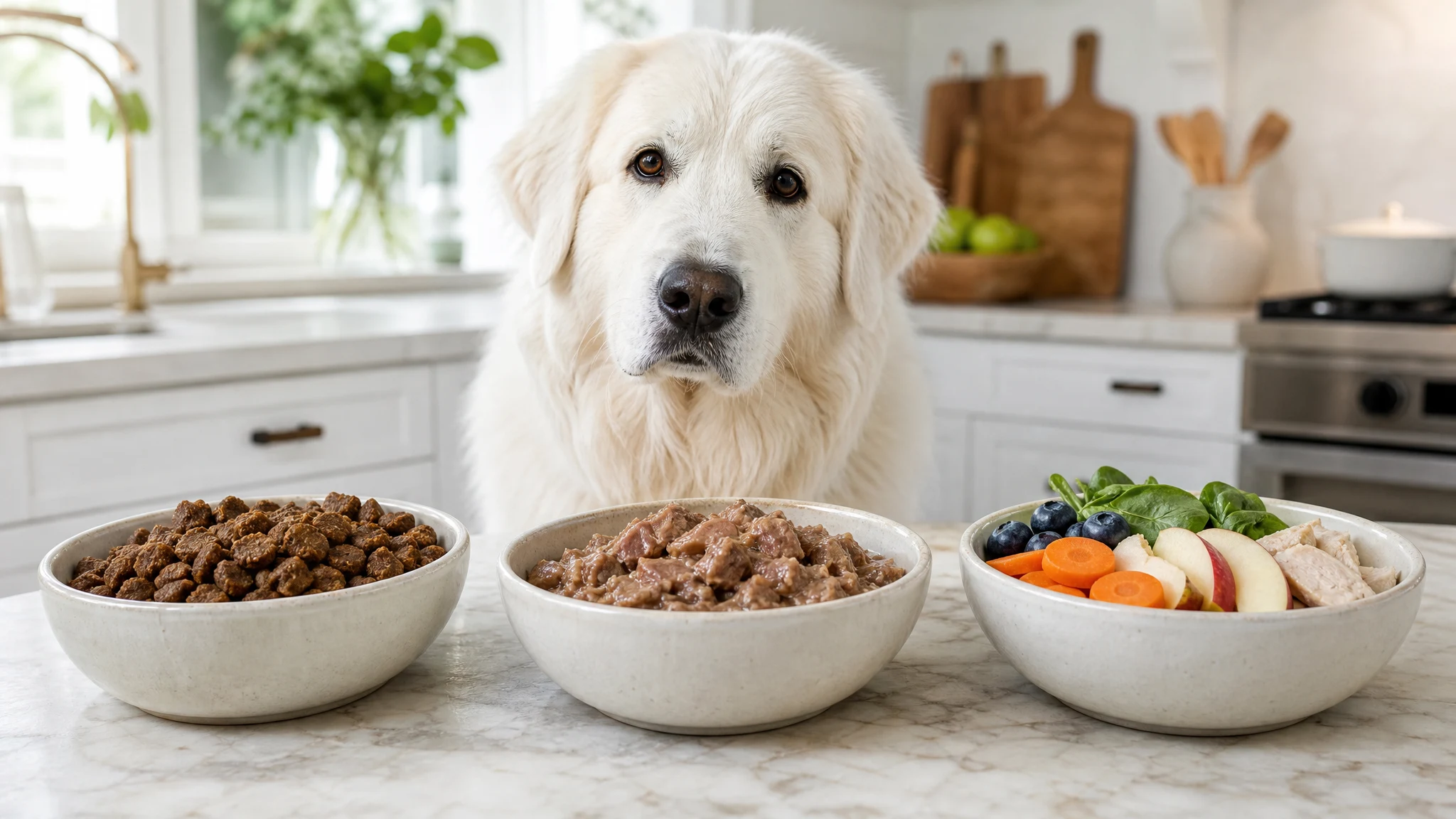
This page compares three forms: dry kibble, canned wet food, and fresh food (refrigerated or shipped frozen). We compared published label data from brand pages. We did not run feeding trials or taste tests, and we are not ranking flavors or how dogs react to them.
How we compared the forms
We used one example product from each form, using only what each brand publishes. Where a brand does not publish something, such as kibble size, we say so and do not guess.
- Dry: Royal Canin Giant Adult Dry, Royal Canin Large Adult Dry, and Hill's Science Diet Adult Large Breed.
- Wet: Hill's Science Diet Puppy Chicken & Barley Entree in the 13 oz can.
- Fresh: Freshpet Large Dog Multi-Protein Recipe, Nom Nom Beef Mash, and JustFoodForDogs Beef & Russet Potato.
One gap to know about: the only wet product in our label set is a general puppy food, not a large-breed formula. We did not find a large-dog adult wet formula with complete label data. Treat wet food findings below as limited, and check each brand's current pages.
For a wider look at specific dry formulas, see our label-by-label dog food comparison for Great Pyrenees.
Side-by-side comparison
| Attribute | Dry | Wet (canned) | Fresh |
|---|---|---|---|
| Moisture | Low. Water is not near the top of the ingredient lists we reviewed. | High. Water is the first ingredient on the Hill's puppy can. | High. The fresh recipes list meat, egg, or vegetables first, and none list water first. |
| Calories per serving | Royal Canin Giant Adult: 427 kcal per cup. Royal Canin Large Adult: 360. Hill's Large Breed Adult: 365. | Hill's puppy can: 495 kcal per 13 oz can (1339 kcal/kg). Per cup is not stated. | Freshpet Large Dog: 348 kcal per cup. Nom Nom Beef Mash: 201 per cup. JustFoodForDogs Beef & Russet Potato: 792 per 18 oz pack, 44 per oz. |
| Cost per day (general terms) | Usually the lowest of the three for a large dog. Check current prices with the brand. | Usually higher than dry when it is the whole diet for a 100 pound dog. | Usually the highest, because large dogs need big daily portions. Check current prices with the brand. |
| Storage | Pantry, sealed. | Pantry until opened, then refrigerate leftovers. | Freshpet is refrigerated. Nom Nom and JustFoodForDogs are shipped frozen. Plan fridge or freezer space. |
| Life stage in our examples | Adult, giant adult, and large-breed adult formulas. | Puppy and pregnant or nursing dogs. Not a large-breed formula. | Freshpet: adult maintenance. Nom Nom: all life stages. JustFoodForDogs: adult maintenance, not for growing puppies. |
| Kibble size | Neither brand page gives kibble dimensions. Royal Canin says its Large Adult kibble is designed for large jaws. | Not applicable. | Not applicable. |
Moisture: what the labels show
The Hill's puppy can lists water first. Dry kibble lists meat, meal, or grain first. That is a real difference in how the foods are made, and it explains why a can looks so different from a scoop of kibble.
We would not read more into it than that. Moisture changes how a food looks, how it smells, and how much of the bowl is water. It does not by itself make one food more complete. A food's AAFCO statement and its calories tell you more about whether it can be a full diet.
Because moisture differs, the guaranteed analysis is hard to compare across forms. A can's percentages are on an as-fed basis and are diluted by water. Hill's shows dry matter averages for its products, such as 29% protein and 20.3% fat for the puppy can. Those are not guaranteed minimums, so do not set them against a kibble's minimums as if they were the same measure.
Calories per serving for a 100 pound dog
Calories per cup is where forms differ most. Royal Canin lists 427 kcal per cup for Giant Adult Dry. Nom Nom lists 201 kcal per cup for Beef Mash. By those numbers, the same calories take roughly twice as many cups of Nom Nom as of the Royal Canin kibble.
For a very large dog, that adds up to a lot of food to store, scoop, and clean up after. Freshpet's 348 kcal per cup sits closer to the kibbles, but its recipe is refrigerated and sold in packs.
Feeding amounts here are only starting points. Royal Canin's Large Adult page has a table by target adult weight and activity level. Hill's tells owners to adjust amounts to maintain an optimal weight. Nom Nom points to its daily feeding guide, and JustFoodForDogs uses a calculator based on calorie needs. Your veterinarian can help set a target for your dog's body condition.
Cost per day, in general terms
We are not quoting prices, because brands change them and we do not have verified numbers. The general pattern is easy to reason through, though. A large dog eats a lot, so the form that costs more per calorie costs much more per day.
- Dry food is usually the most economical way to feed a 100 pound dog.
- Canned food as the whole diet takes many cans a day for a dog this size, so most owners use it as a topper or occasional meal.
- Fresh food is usually the priciest daily option for large dogs. Check the brand's current pricing and shipping terms before committing.
Check each brand's own site for current prices and subscription terms.
Dental myths
A common belief is that dry food cleans teeth and wet food ruins them. None of the sources we used for this page make that claim, so we will not repeat it as fact. A kibble's crunch is not the same as a dental treatment or toothbrushing.
If you are weighing dental health, ask your veterinarian about your dog's teeth and about care routines. Do not pick a food form on this myth alone.
Pros and cons of each form
Dry food
Pros
- Widest range of large and giant breed formulas. Royal Canin and Hill's both publish adult and puppy options sized by weight.
- Easy to store and measure.
- Usually the lowest daily cost for a big dog.
Cons
- Calorie density varies, from 352 to 427 kcal per cup in the examples above, so scoop size matters.
- Brand pages do not list kibble dimensions, so check the brand if kibble size matters for your dog.
Wet food
Pros
- High moisture, with water listed first on the label we reviewed.
- Can be used as a topper over a complete dry food.
Cons
- The only wet product in our set is a general puppy food, not a large-breed formula.
- Many cans per day for a large dog if fed as the only food, which drives up cost.
- Per-cup calories are not listed for the can we reviewed, so portioning takes extra care.
Fresh food
Pros
- Ingredient lists start with real meat, egg, or vegetables, with no water listed first.
- Some recipes cover more than one life stage. Nom Nom states all life stages, including growth of large-size dogs (70 pounds or more as adults), per its page.
- Portions are set by calculators tied to calorie needs.
Cons
- Needs refrigerator or freezer space for a large dog's daily portions.
- Usually the highest cost per day for a giant breed.
- JustFoodForDogs says its recipe is not intended for growing puppies, so check the life stage on any fresh product.
Mixing forms
Many owners mix, such as dry food with a spoonful of wet or fresh on top. It is a reasonable way to add variety. Our sources do not set rules for mixing, so keep these points in mind.
- Calories add up. If you add a topper, reduce the main food so the total stays near your dog's target.
- The base food should carry the complete and balanced statement. Check the AAFCO wording on the label.
- Keep the life stage in line. A puppy needs large-breed puppy nutrition, and an adult needs an adult-appropriate food.
- Change foods gradually and ask your veterinarian if your dog has stomach trouble.
Breed points that affect the choice
Puppies. Hill's says Great Pyrenees puppies need large-breed nutrition until at least 18 months, and that calcium and phosphorus ratios matter for bone development. PetMD says the breed generally does well on food formulated for large breeds. AAFCO rules say growth and all-life-stages foods must state whether they include or exclude growth of large-size dogs (70 pounds or more as an adult). A Great Pyrenees falls in that class, so look for the wording 'including growth of large-size dogs'.
Among the labels we reviewed, Hill's Puppy Large Breed Chicken & Brown Rice is labeled for large breed puppies up to 18 months. The Hill's wet puppy entree is a general puppy food, not a large-breed formula. For those reasons it is a poor fit as the main food for a Great Pyrenees puppy. VICTOR Hi-Pro Plus Large Breed Puppy is an all-life-stages dry food. Check its full label wording with the brand.
Bloat. PetMD describes bloat (GDV) as life-threatening. It advises several small meals, avoiding vigorous exercise around mealtimes, and avoiding raised bowls. It also notes that a gastropexy is often done to lower the chance of bloat. Those are feeding habits, not a food form, so no form is a cure or a guard. Talk to your veterinarian about your own dog.
Joints and weight. Hill's says hip and elbow dysplasia can occur in large dogs, and that controlled growth and moderate exercise support joints. PetMD says exercise, weight, and nutrition can influence these conditions. Fresh and wet foods can be calorie dense or calorie light, so measure portions whichever form you pick.
Heart disease. The FDA has investigated a possible link between certain diets and canine dilated cardiomyopathy. The latest update on that page is dated December 23, 2022, and the FDA does not plan further public updates until there is meaningful new scientific information. Ask your veterinarian if you have questions about your dog's diet.
Best for: use cases
- Everyday feeding on a sensible budget: a large or giant breed dry food. Royal Canin and Hill's both publish adult formulas for this weight range.
- A Great Pyrenees puppy: a large-breed puppy dry food or a fresh food whose label says it includes growth of large-size dogs. Hill's recommends large-breed puppy nutrition until at least 18 months.
- Picky or low-appetite days: a spoonful of wet or fresh food over the dry, with the main portion reduced to match. Ask your veterinarian if appetite loss continues.
- Owners who value fresh ingredients and have freezer space: a fresh food with a clear life-stage statement, such as Freshpet or Nom Nom for adults.
- Older dogs: Hill's lists an Adult 6+ Large Breed dry food for dogs 6 years and up. Your veterinarian can say whether it suits your dog.
The verdict
For most Great Pyrenees owners, a complete dry food made for large or giant dogs is the practical base. It is the form with the most large-breed options, the simplest portioning, and the lowest daily cost for a dog of 85 to 120 pounds.
Wet food works best as a topper or occasional meal. The one wet product we reviewed is a puppy food that is not large-breed, so we cannot recommend it as a full diet for this breed.
Fresh food is a sound choice if the budget and storage space fit and the label states the right life stage. Nom Nom's all-life-stages wording and Freshpet's adult maintenance wording are examples of the clarity to look for.
Whatever you choose, measure portions, watch body condition, and ask your veterinarian before changing your dog's diet. Prescription diets are something only a veterinarian prescribes. For more formulas, see our label-by-label comparison.
Sources
- Hill's Pet: Great Pyrenees breed page
- PetMD: Great Pyrenees breed page
- Westminster Kennel Club: Great Pyrenees breed page
- FDA Center for Veterinary Medicine: diets and canine dilated cardiomyopathy
- Royal Canin: Giant Adult Dry
- Royal Canin: Large Adult Dry
- Hill's Science Diet: Adult Large Breed
- Hill's Science Diet: Puppy Chicken & Barley Entree
- Freshpet: Large Dog Multi-Protein Recipe
- Nom Nom: Beef Mash
- JustFoodForDogs: Beef & Russet Potato