Best Training Treats for Great Pyrenees (and How Many to Give)
General nutrition information compiled from product labels and published sources, not veterinary advice. Your veterinarian is the right person to choose a diet for your dog, especially one with a health condition.
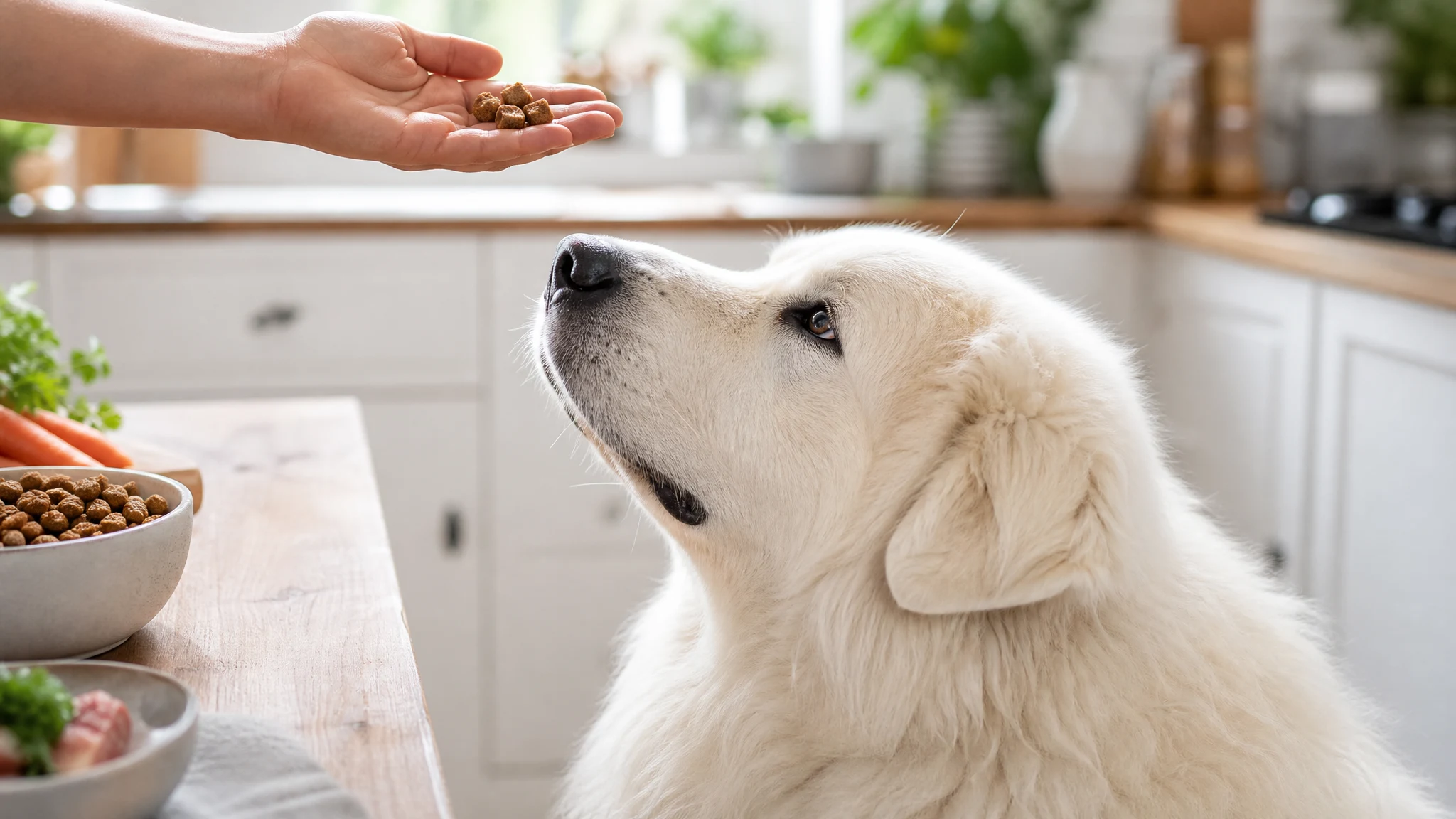
Picking the best treats for Great Pyrenees is less about a magic brand and more about three things: the type of treat, the size of each piece, and how many calories the whole day adds up to. This guide walks through each step.
A Great Pyrenees is a large dog. Hill's Pet lists adults at 85 to 120 pounds, with males heavier. That size means the number of treats can add up fast over a day of training, even when each piece looks tiny.
What this guide covers
You will learn how to pick a treat category, cut treats to a useful size, count treat calories against the daily food, and run short reward-based sessions. The methods follow the humane, reward-based approach supported by the American Veterinary Society of Animal Behavior (AVSAB).
We did not feed or taste-test any treats. Where we mention food, we are comparing what the brands publish on their own pages. For a full look at the main meals, see our label-by-label comparison of dog foods for Great Pyrenees.
Materials you will need
- Two or three treat types from different categories (see Step 2)
- A small sharp knife and a cutting board, or kitchen scissors, for shrinking soft treats
- A treat pouch or a small container you can reach quickly
- A kitchen scale or measuring spoons, so you can portion the day's treats in advance
- The calorie information from the treat package and from your dog's regular food
- A daily calorie target from your veterinarian
Step 1: Know your dog's daily calorie target
Treat counting starts with the whole day's food. Ask your veterinarian how many calories your dog needs each day. That number depends on age, body condition and activity, and it is not something a website can set for an individual dog.
The brand pages we reviewed show how different foods are in calorie density. Royal Canin's page lists Giant Adult Dry at 427 kcal per cup and Large Adult Dry at 360 kcal per cup. Hill's lists its Science Diet Adult Large Breed at 365 kcal per cup. Two cups of one food are not the same as two cups of another, so measure treats in calories, not in handfuls.
Feeding amounts on bags and brand calculators are starting points. Your veterinarian can help you adjust from there.
Step 2: Choose a treat category
Rather than hunting for one winner, think in categories. Different jobs call for different treats. We are not naming specific treat products here, because we have no label data on any to share. Read each package yourself.
Soft training treats
Soft, moist treats are easy to break into small pieces and quick to swallow. That keeps a session moving. Check the package for a calorie count per treat or per piece, and look for a complete ingredient list. If the package gives no calorie figure, check with the brand before relying on it.
Freeze-dried single-protein treats
Single-protein treats, such as one kind of meat, have a short ingredient list. That makes it simpler to see what your dog is eating, and simpler to spot a food that does not agree with them. They are usually light and crumble into tiny bits. They also tend to be a strong reward, so save them for harder jobs like coming when called outdoors.
Vegetables
Some dogs will work for small bits of dog-safe vegetables, such as plain carrot pieces. These are a low-effort way to add rewards without many extra calories. Ask your veterinarian which vegetables suit your dog, and introduce any new food slowly.
A mix works well. Use the vegetable or a piece of kibble for easy repeats, and the soft or freeze-dried treat for the moments that matter most.
Step 3: Apply the 10 percent rule
A common guideline, which the World Small Animal Veterinary Association (WSAVA) nutrition guidance is often cited for, is to keep treats to no more than about 10 percent of daily calories. The rest should come from a complete and balanced diet. Confirm the right share for your dog with your veterinarian, since some dogs need less.
Here is the arithmetic, using a made-up number only to show the method. If a veterinarian set a dog's target at 1,000 calories a day, treats would stay near 100 calories. If the dog gets 30 treats, each one should average about 3 calories.
Then subtract the treats from the meal. If you plan a big training day, feed a little less at dinner. Ask your veterinarian how much to trim.
This matters for the whole life of the dog. Hill's gives the breed a life expectancy of 10 to 12 years, and extra weight is a common reason owners and veterinarians talk about changing the food plan.
Step 4: Size the treats for a large dog
It is tempting to hand a big dog a big treat. For training, go the other way. A piece about the size of a pea or a fingernail clipping is usually enough for a dog of this size, and a tiny piece lets you reward 20 or 30 times in a session without overdoing calories.
Why small works:
- The dog swallows in a second and is ready for the next cue.
- You can reward more often, which helps new behaviors stick.
- Calories stay under your daily budget.
Cut or break soft treats on the cutting board before the session, and pack the pieces in your pouch.
Step 5: Portion the day's treats in advance
- Work out the treat calories for the day (Step 3).
- Divide that by the calories in one cut piece, to get a piece count.
- Count that many pieces into a container each morning.
- When the container is empty, treats are done. Anything given by family members comes from the same container.
This one habit prevents most accidental overfeeding.
Step 6: Run short, reward-based sessions
- Pick one cue to practice, such as sit, down or a hand target.
- Mark the right behavior with a word like "yes" or a clicker, then hand over a treat within a second or two.
- Reward each correct repeat at first. As the dog gets reliable, reward every second or third repeat and mix in praise.
- End after a few minutes while the dog is still keen.
- If the dog gets it wrong, simply reset and make the next step easier. Do not use force, harsh corrections or intimidation.
Time sessions with care around meals. PetMD notes that Great Pyrenees can develop bloat, also called GDV, a life-threatening condition. PetMD advises multiple small meals and avoiding vigorous exercise around mealtimes. Keep training calm and low-energy near meals, and ask your veterinarian about your own dog's risk and feeding schedule.
Special notes for puppies
Hill's says Great Pyrenees puppies need large-breed nutrition until at least 18 months, and that calcium and phosphorus ratios matter for bone development. Heavy treat feeding can crowd out the balanced food, so keep puppy treats small and few, and count them in the day's calories. Ask your veterinarian before adding calcium-rich extras to a growing puppy's day.
Also, full adult size can take up to two years, so the calorie target will change as your puppy grows. Recheck it with your veterinarian during growth.
Tips for better results
- Rank your treats. Use a lower-value treat for easy cues and a higher-value one for distractions.
- Read the label. A treat should list its ingredients and, ideally, calories per piece. If key information is missing, check with the brand.
- Introduce one new treat at a time. If your dog has loose stools or seems unwell, stop and call your veterinarian.
- Use part of the meal. Some owners train with a portion of the daily kibble, which cuts down on extra calories.
- Keep a log for a week. Jot down treats given so the numbers are real, not guessed.
Common mistakes to avoid
- Treats that are too large. One big biscuit can use up a training session's worth of calories.
- Not counting the extras. Chews, table scraps and treats from visitors all count toward the daily total.
- Treating a treat as a cure. No treat prevents or treats a health condition such as hip dysplasia or allergies. Hill's notes that controlled growth and moderate exercise support joints in large breeds, and PetMD says weight and nutrition can influence hip and elbow problems. A veterinarian decides what is right for an individual dog.
- Training right before or after a big meal. See the bloat note above.
- Keeping the same food reward forever. If your dog loses interest, switch categories before raising the amount.
What to expect
With small, well-timed rewards, many dogs learn simple cues over several weeks of short daily practice. Results vary with age, temperament and consistency, so treat any timeline as a rough guide. Counting treats may also help you keep your dog's weight steady, though it cannot promise a particular outcome.
If your dog loses weight, gains weight, or stops showing interest in food, talk with your veterinarian before changing the plan.
When to ask your veterinarian
- Before setting a daily calorie target or a treat share
- If your dog has a medical condition, food sensitivity or takes medication
- If your puppy's growth, weight or appetite seems off
- If you plan to switch the main diet. Prescription diets are something only a veterinarian prescribes.