Great Pyrenees Feeding Chart by Weight, Not Just Age
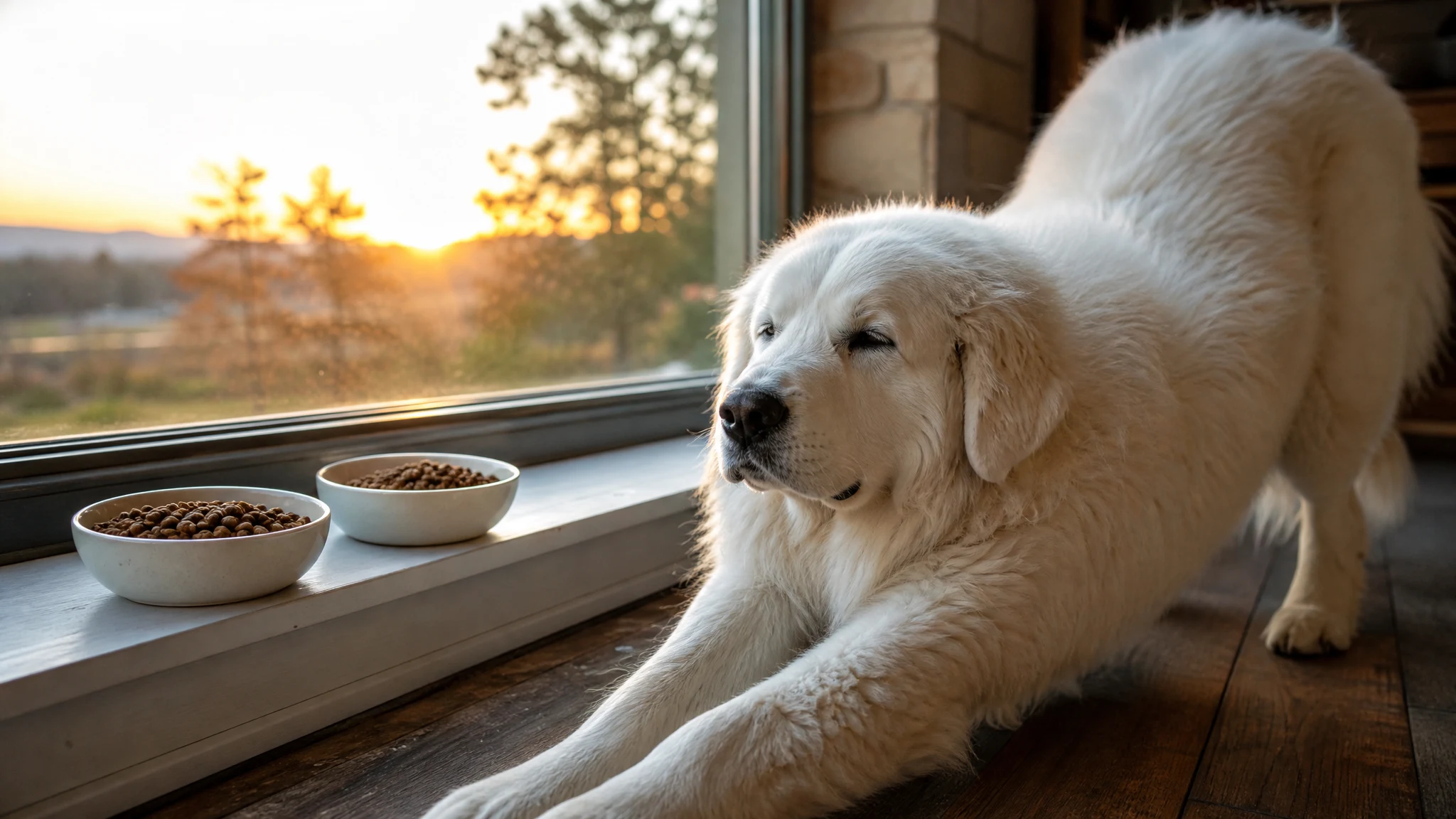
General nutrition information compiled from product labels and published sources, not veterinary advice. Your veterinarian is the right person to choose a diet for your dog, especially one with a health condition.
Most feeding charts start with age. That helps for puppies, but it leaves out a lot. Two adult Great Pyrenees can differ by 35 pounds and still be "adults." Hill's Pet lists the breed at 85 to 120 pounds, with males heavier. Activity level and the food itself change the answer too.
This guide shows you how to build your own dog feeding chart by weight. You will use the label guide on your dog's food and adjust it by watching your dog. For an age-based view, see the companion page, how much to feed a Great Pyrenees by age.
One note on method. We compared label data published by the brands. We did not run feeding trials or taste tests, and we have not fed these foods to dogs.
Why weight matters more than age for this breed
The Westminster Kennel Club lists the Great Pyrenees as a large breed. Hill's says puppies need large-breed nutrition until at least 18 months, and full adult size can take up to two years. So age tells you which type of food to buy. It does not tell you how many cups to scoop.
Weight does. A 90 pound dog and a 118 pound dog have different energy needs, even at the same age. A dog that guards a farm all day may need more than a dog that naps indoors. That is why most brands print their guide by body weight.
What you need
- A scale. A bathroom scale works: weigh yourself, then weigh yourself holding your dog, and subtract.
- The food bag or can, with its feeding guide and calorie statement.
- A standard dry measuring cup. Scoops that come with the food vary, so check what size yours is.
- A notebook or phone note to log weight, amounts and treats.
- Your veterinarian's phone number, for any dog with a health condition.
Step 1: Check that the food fits the life stage
Start with the AAFCO statement on the label. According to the Dog Food Advisor's summary of AAFCO profiles, growth and all-life-stages foods must say whether they include or exclude growth of large-size dogs, meaning dogs of 70 pounds or more as adults. A Great Pyrenees falls in that class. For a puppy, look for wording that includes growth of large-size dogs. We could not confirm the large-size wording on every product below, so check the bag itself.
Hill's also says calcium and phosphorus ratios matter for bone development in this breed. That is a reason to pick a large-breed puppy food rather than a general one. A general puppy food, such as the Hill's Science Diet Puppy Chicken & Barley canned entree, is not a large-breed formula according to its product page.
Step 2: Weigh your dog
Weigh your dog and write the number down. For a puppy, weigh every week or two. For an adult, once a month is a reasonable habit. Always use the same scale and time of day if you can.
Step 3: Find the weight row on the label guide
Brands set their guides differently, so here is what the published pages say:
- Royal Canin Large Adult lists daily amounts by target adult weight (57 to 97 pounds) and activity level.
- Royal Canin Giant Adult, for dogs over 100 pounds, points to an online feeding calculator instead of a printed table.
- Hill's Science Diet pages give a weight-based chart and say to adjust amounts as needed to maintain optimal weight.
- VICTOR Hi-Pro Plus Large Breed Puppy has breed-specific charts by age and weight. For adults over 100 pounds, its page says to increase feeding by 1/2 cup for every 20 pounds over 100 pounds.
We are not printing cup amounts here. Those numbers belong to each brand, and they change with the recipe. Read them from the current bag or the brand's own page. If you are between two rows, start with the row for your dog's current weight, not a goal weight, unless your vet says otherwise.
Step 4: Compare calories per cup
Cups are not a fair comparison between foods. This table shows the calories per cup that each brand lists.
| Food (dry) | Stage and size range on the label | Calories per cup |
|---|---|---|
| Royal Canin Giant Puppy | Giant puppies, up to 8 months | 338 kcal ME |
| Royal Canin Large Adult | Adults 56 to 100 lb | 360 kcal ME |
| Royal Canin Giant Adult | Adults over 100 lb | 427 kcal ME |
| Hill's Science Diet Adult Large Breed Chicken & Barley | Large 1 to 5 years, 55 to 110 lb | 365 kcal |
| Hill's Science Diet Puppy Large Breed Chicken & Brown Rice | Large-breed puppies, up to 18 months | 387 kcal |
| Hill's Science Diet Adult 6+ Large Breed | Mature large 6+ years | 352 kcal |
| VICTOR Hi-Pro Plus Large Breed Puppy | All life stages | 365 kcal |
Royal Canin's Giant Adult has about 67 more calories per cup than its Large Adult. A Great Pyrenees at 85 to 120 pounds can fall in either weight range. Check which line the brand suggests for your dog's size, and ask your vet if you are unsure.
Fresh and frozen foods are listed differently. Freshpet Large Dog Multi-Protein shows 348 kcal per cup. Nom Nom Beef Mash shows 201 kcal per cup. JustFoodForDogs Beef & Russet Potato gives 44 kcal per ounce and no per-cup figure. Nom Nom's page lists all life stages including large-size growth, while the JustFoodForDogs recipe is for adult maintenance and is not intended for growing puppies. Always follow each brand's own calculator for these.
Step 5: Set the schedule
PetMD notes that bloat, also called GDV, is life-threatening in this breed. It advises several small meals, avoiding vigorous exercise around mealtimes, and avoiding raised bowls. It also says a gastropexy is often done to help prevent GDV. Whether surgery makes sense is a decision for your vet.
In practice, split the daily amount into at least two meals. Some owners use three for young puppies. Freshpet's page says its food can be fed as one meal or divided into two, so for a dog this size, two is the safer reading. Keep a quiet half hour around meals.
Step 6: Check body condition and adjust
The label amount is a starting point. Every 2 to 4 weeks, run your hands along your dog's ribs. Under a thick coat, you must feel with your fingers, not just look. You should be able to feel the ribs without pressing hard. A visible waist from above is also a good sign.
If you cannot feel ribs, trim the daily amount slightly and recheck. If ribs are sharp and obvious, increase slightly. Small changes, then a few weeks of watching, work better than big swings. Log each change.
Step 7: Count treats and change foods slowly
Treats, chews and training rewards add calories. Keep them modest and take them out of the day's total. When you switch foods, mix the new with the old over about a week, and watch stools. Because cups differ so much between foods, do not swap cup for cup.
Common mistakes to avoid
- Feeding by age alone. A 14 month old and a 24 month old may weigh very differently.
- Using the wrong life stage. A large-breed puppy needs large-breed puppy nutrition until at least 18 months, per Hill's.
- Assuming a cup is a cup. The table above shows why it is not.
- Judging by coat. That thick double coat hides weight changes.
- Heavy exercise right after meals. PetMD advises against it for bloat risk.
- Treating a health issue with food choices alone. Hill's notes hip and elbow dysplasia can occur in large breeds and that controlled growth and moderate exercise support joints. PetMD says nutrition can influence them. Neither source says a food prevents or cures them.
Dogs with health conditions
If your dog has a health condition, or is losing or gaining weight without explanation, confirm every amount with your veterinarian. Hill's lists Addison's disease in some lines and says bone cancer is more frequent in giant breeds, with regular exams advised. Prescription diets are something only a veterinarian prescribes.
On supplements, do not add them to a food on your own. Ask your vet whether one is needed and what amount is right for your dog.
The FDA has looked at a possible link between certain diets and canine dilated cardiomyopathy. Its page was last updated on December 23, 2022, and the FDA says it does not plan more public updates until there is meaningful new scientific information. If you have questions about your dog's food, bring them to your vet.
What to expect
With steady weighing, measuring and body checks, many owners find their dog holds a stable, healthy weight and has regular stools. Results vary by dog, and a good feeding routine may support a healthy weight but cannot promise a particular outcome. Expect to adjust a few times in the first couple of months, and again as your dog moves from puppy to adult to senior food.
Hill's lists a life expectancy of 10 to 12 years for the breed. That is a long stretch of meals, so a simple tracking habit pays off.
Quick worksheet
- Write today's weight and date.
- Write the food name and its calories per cup from the label.
- Copy the label's daily amount for that weight.
- Divide it into at least two meals.
- Recheck body condition in 2 to 4 weeks and note any change.
Sources
- Westminster Kennel Club breed page
- Hill's Pet Great Pyrenees breed page
- PetMD Great Pyrenees breed page
- Dog Food Advisor on AAFCO nutrient profiles
- FDA Center for Veterinary Medicine: diets and canine dilated cardiomyopathy
- Royal Canin Giant Adult, Large Adult, Giant Puppy
- Hill's Science Diet Adult Large Breed, Puppy Large Breed, Adult 6+ Large Breed, Puppy Chicken & Barley canned
- VICTOR Hi-Pro Plus Large Breed Puppy
- Freshpet Large Dog Multi-Protein Recipe
- Nom Nom Beef Mash
- JustFoodForDogs Beef & Russet Potato