Grain-Free Food and Great Pyrenees: What the FDA DCM Investigation Found
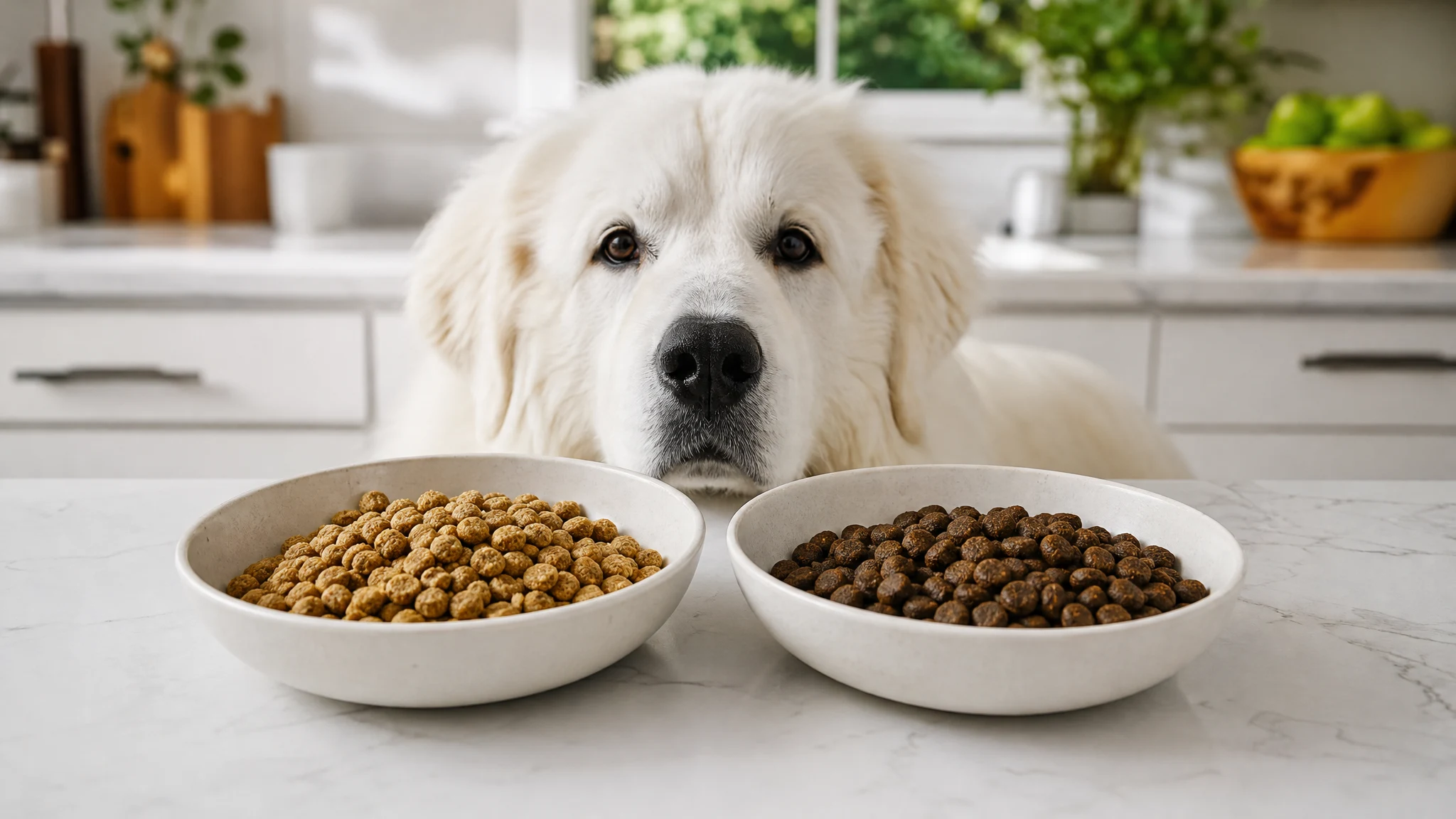
General nutrition information compiled from product labels and published sources, not veterinary advice. Your veterinarian is the right person to choose a diet for your dog, especially one with a health condition.
If you own a Great Pyrenees, you have probably seen warnings about grain free dog food and heart disease. The headlines can be confusing. Some sound alarming, and some sound dismissive.
This guide walks you through a calm way to sort it out. You will read what the FDA actually published, check your own dog's food label, and prepare a short list of questions for your veterinarian. It does not tell you what to feed. It helps you ask better questions.
The short version
Dilated cardiomyopathy, or DCM, is a heart condition in which the heart muscle weakens. The FDA Center for Veterinary Medicine has run an investigation into a potential link between certain diets and canine DCM. The word "potential" matters. It describes a question under study, not a settled finding.
According to the FDA Center for Veterinary Medicine, the latest update on its investigation page is dated December 23, 2022. The FDA also says it does not plan further public updates until there is meaningful new scientific information. So the page has not changed in a while, and that is by design.
Materials you will need
- Your dog's current food bag or can, including the full label (front and back).
- Your dog's age, current weight, and any health notes from past vet visits.
- The FDA investigation page, linked in the Sources list below.
- A notepad or phone note for questions.
- About 20 minutes.
Step 1: Read what the FDA actually says
Start with the primary source rather than a social media summary. Open the FDA Center for Veterinary Medicine page on its investigation into a potential link between certain diets and canine dilated cardiomyopathy.
As you read, sort statements into three piles:
- Stated facts: what the FDA reports and when it last updated the page.
- Open questions: anything the FDA describes as potential, possible or still being studied.
- Your assumptions: anything you brought with you from forums or ads.
Keep the third pile small. Most of the panic and most of the dismissal online comes from that pile.
Step 2: Understand what is and is not known
Here is a fair way to summarize the state of things, based on the FDA's own framing.
What the FDA has said: It investigated a potential connection between certain diets and DCM, and its most recent update on the page is dated December 23, 2022. It does not expect more public updates without meaningful new science.
What should be treated as unsettled: Because the FDA calls the link "potential," you should not read the page as proof that grain free dog food causes DCM. You should also not read it as proof that grain free food is safe. Neither conclusion is supported by the page title alone. For anything more specific, such as which ingredients or which dogs, read the FDA page itself and ask your veterinarian rather than relying on a summary, including this one.
This is the honest answer to the question many owners type: is grain free bad for Great Pyrenees? No source we relied on says so for this breed. No source we relied on says it is fine, either. That gap is exactly why a vet conversation is useful.
Step 3: Check what is said about the breed
Next, look at what reputable breed health pages list for the Great Pyrenees. The Hill's Pet breed page and the PetMD breed page, both linked below, discuss the following diet-relevant concerns:
- Hip and elbow dysplasia. Hill's says these can occur in large-breed dogs and that controlled growth and moderate exercise support joints. PetMD says they are hereditary and that exercise, weight and nutrition can influence them.
- Bloat (GDV). PetMD calls it life-threatening and advises multiple small meals, avoiding vigorous exercise around mealtimes, and avoiding raised bowls. It notes a gastropexy is often done in connection with GDV.
- Osteosarcoma. Hill's says this bone cancer is more frequent in giant breeds and advises regular exams.
- Addison's disease. Hill's says some lines are predisposed.
DCM does not appear on those lists for this breed. That is not the same as saying the breed is immune. It only means the breed pages we relied on do not state a DCM predisposition. If you want a firmer answer for your own dog, ask your veterinarian and the national breed club or your dog's breeder about heart health in your dog's family line.
Step 4: Read your dog's food label
Now turn to the bag. Write down the following, exactly as printed:
- The product name and form. Dry, canned, fresh or frozen.
- The AAFCO statement. It tells you the life stage the food is formulated for. Look for wording about growth or all life stages.
- The first five ingredients. Ingredients are listed by weight before cooking, so they only give a rough picture.
- The guaranteed analysis. Minimum protein and fat, maximum fiber and moisture.
- The calories per cup. You will need this if you ever compare foods.
A food is only "grain free" if the label or brand page says so or the ingredient list shows no grains. Some brands do not make a grain-free claim even when their ingredient lists show no grains, so the claim and the ingredients are not always the same thing. When a brand page does not say, treat it as unknown and ask the brand.
As one example of how this looks on a real brand page, the JustFoodForDogs Beef & Russet Potato page is listed as grain free, and it is described as adult maintenance, not for growing puppies. That is a label fact, not a verdict on the food in either direction.
Step 5: Match the food to your dog's life stage and size
For a Great Pyrenees, this check often matters more than the grain question. Adults weigh 85 to 120 pounds according to Hill's, and the Westminster Kennel Club lists the breed as large.
AAFCO says growth and all-life-stages foods must state whether they include or exclude growth of large-size dogs, meaning dogs expected to reach 70 pounds or more as adults. A Great Pyrenees falls in that group. For a puppy, look for wording like "including growth of large-size dogs." The secondary source we used for this rule is Dog Food Advisor, so confirm the exact wording against AAFCO or with your veterinarian.
Hill's says Great Pyrenees puppies need large-breed nutrition until at least 18 months, and that calcium and phosphorus ratios matter for bone development. Full adult size can take up to two years. PetMD says the breed generally does well on food formulated for large breeds.
So a grain-inclusive food that is wrong for your dog's life stage is not a better choice than a grain-free one that fits, and the reverse is also true. Fit comes first.
Step 6: Compare options by label data only
If your veterinarian suggests looking at other foods, compare them on paper. Our label-by-label comparison of dog foods for Great Pyrenees shows how that works. We compared published label and brand page data. We did not run feeding trials or taste tests, and we did not feed any of these foods to dogs.
Whatever you compare, keep the same columns for each food: AAFCO statement, first five ingredients, guaranteed analysis, calories per cup, and whether the brand states a size or life stage. Feeding amounts on a label are starting points. Your dog's body condition decides the real amount.
Step 7: Take your questions to your veterinarian
This is the step that matters most. Your veterinarian knows your dog's history, and no article can replace that. Bring your notes and ask:
- Is my dog's current food appropriate for their age and size?
- Given what the FDA has published, do you have any concern about this food for my dog?
- Should heart health be part of my dog's regular checkups?
- If we change foods, how should we transition, and what should I watch for?
- Are there signs of heart trouble I should report right away?
Do not change your dog's diet suddenly because of a headline. A sudden switch can upset the stomach on its own. Any change should be planned with your veterinarian. Prescription diets are something only a veterinarian prescribes.
Tips
- Take a photo of the label and the lot information so you have it at the vet.
- Check the date on any article, including this one, against the FDA page itself.
- Keep feeding routines steady while you gather information.
- For bloat risk, follow the meal-timing advice above and talk to your vet about it separately from the DCM question.
Common mistakes to avoid
- Treating "potential link" as proof. The FDA's own wording is cautious. Match that tone.
- Treating a quiet FDA page as an all-clear. No new updates since December 2022 is not the same as a final answer.
- Ignoring life stage. A puppy on an adult-only food, or a large-breed puppy on food that excludes large-size growth, is a bigger practical problem than many owners realize.
- Judging by the front of the bag. Marketing words are not label data. Read the AAFCO statement and the analysis.
- Switching abruptly or self-prescribing. Diet changes belong in a plan with your vet.
- Expecting food to take the place of veterinary care. No food is shown here to prevent or cure hip dysplasia, bloat, DCM or anything else. The sources only say nutrition can influence some conditions.
What to expect afterward
After these steps, you should be able to explain your dog's current food in plain terms, say what the FDA has and has not stated, and arrive at the vet with specific questions. Many owners find the topic feels less frightening once it is written down.
You may or may not end up changing foods. Either outcome can be reasonable. Results vary by dog, and nothing here can promise a particular health outcome. Your veterinarian is the one who can weigh your dog's age, weight, heart exam and history.
Sources
- FDA Center for Veterinary Medicine: investigation into a potential link between certain diets and canine dilated cardiomyopathy
- Hill's Pet: Great Pyrenees breed page
- PetMD: Great Pyrenees breed page
- Westminster Kennel Club: Great Pyrenees breed page
- Dog Food Advisor: AAFCO nutrient profiles (secondary source)
- JustFoodForDogs: Beef & Russet Potato product page