How Dog Nutrition Needs Change as a Great Pyrenees Ages
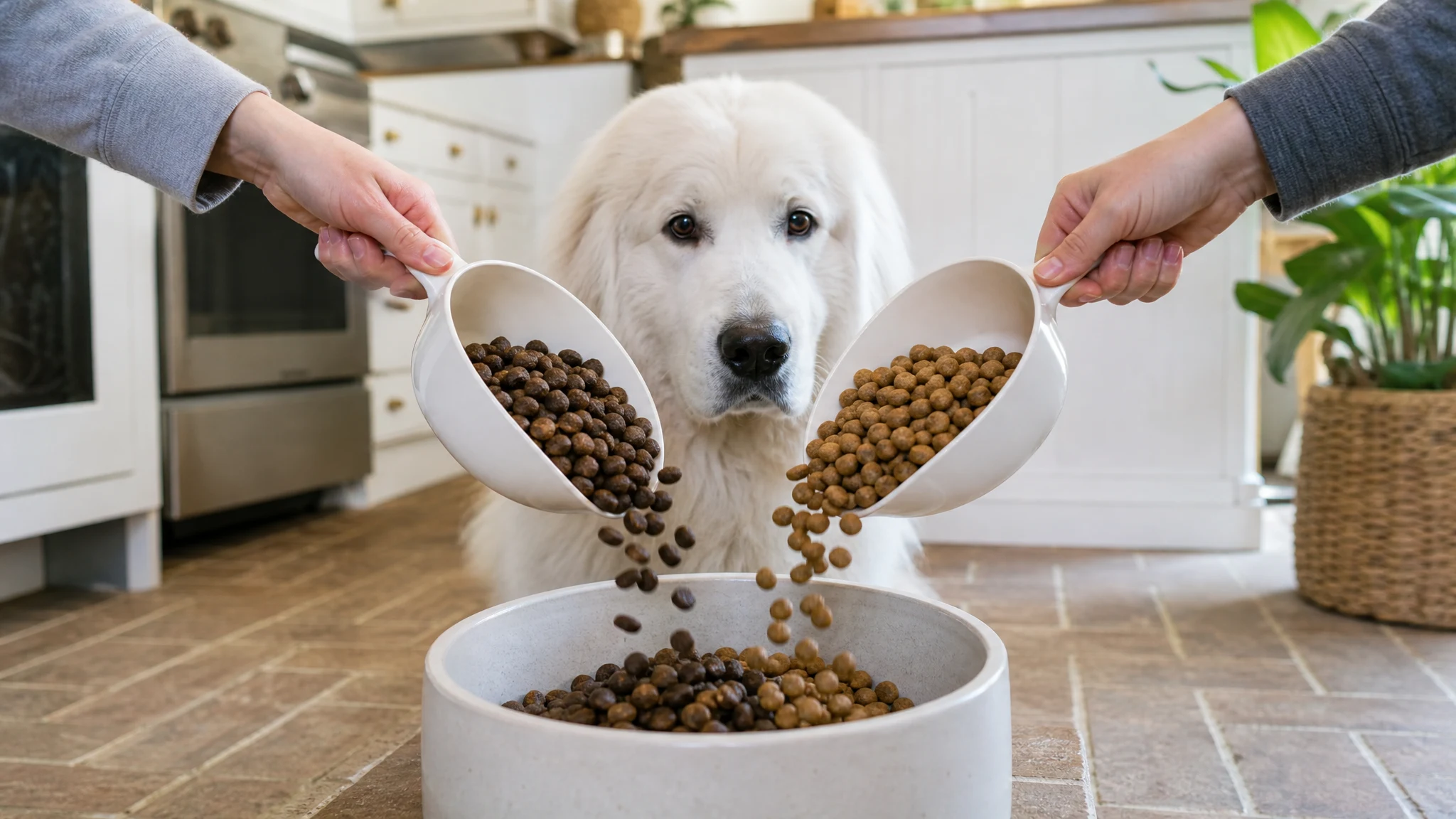
General nutrition information compiled from product labels and published sources, not veterinary advice. Your veterinarian is the right person to choose a diet for your dog, especially one with a health condition.
A Great Pyrenees does not eat the same way at 4 months, 4 years and 9 years. Growth, body weight and joint care all shift over time, and the food label should shift with them.
This guide walks you through matching the food to each life stage. We compared label data published by the brands. We did not run feeding trials or taste tests, and nothing here replaces your veterinarian's advice for your own dog.
What You Need Before You Start
- Your dog's current weight and age, ideally from a recent vet visit.
- The bag, can or tray label of the food you feed now, including the nutritional adequacy statement.
- A kitchen scale or a marked measuring cup, so portions are consistent.
- A notebook or phone note for weight, appetite and stool changes.
- Your veterinarian's contact details, since every change below is best confirmed with them.
Know the Breed Basics First
The Westminster Kennel Club lists the Great Pyrenees as a large breed. Hill's Pet gives an adult weight range of 85 to 120 pounds, with males heavier, and a life expectancy of 10 to 12 years.
Those numbers matter for food choice. Many labels sort dogs by adult weight, and a Great Pyrenees can land in the large or the giant group depending on size. For more on the wider picture, see our guide to the diet factors that matter for a Great Pyrenees.
Step 1: Feed Large-Breed Puppy Nutrition Through Growth
Hill's Pet says Great Pyrenees puppies need large-breed nutrition until at least 18 months, and that full adult size can take up to two years. Hill's also notes that calcium and phosphorus ratios matter for bone development.
Dog Food Advisor explains that AAFCO growth and all-life-stages foods must state whether they include or exclude growth of large-size dogs, meaning dogs 70 pounds or more as adults. A Great Pyrenees is in that class. Look for wording like "including growth of large-size dogs."
On the label side, a few foods are worth knowing about:
- Hill's Science Diet Puppy Large Breed Chicken & Brown Rice: labeled for large-breed puppies up to 18 months, at 387 kcal per cup according to Hill's.
- Royal Canin Giant Puppy: aimed at giant-breed puppies up to 8 months, at 338 kcal per cup. Royal Canin's page says the statement is for growth, but check the full sentence on the bag for large-size wording.
- VICTOR Hi-Pro Plus Large Breed Puppy: an all-life-stages food at 365 kcal per cup, with 30% minimum protein and 14% minimum fat per VICTOR.
The Hill's Science Diet Puppy Chicken & Barley canned food is a general puppy formula, not a large-breed one, so ask your vet before using it as the main diet.
Hill's says hip and elbow dysplasia can occur in large breeds, and that controlled growth and moderate exercise support joints. PetMD adds that these conditions are hereditary, and that exercise, weight and nutrition can influence them. No food prevents or treats them, so your vet guides the plan.
Step 2: Move to an Adult Food at the Right Time
Do not switch at a fixed birthday. Switch when your vet agrees growth is finished, which for this breed is often after 18 months and sometimes closer to two years.
Then pick a food whose label matches your dog's adult weight. Some examples from brand pages:
| Food | Stated weight group | Calories |
|---|---|---|
| Royal Canin Large Adult | 56 to 100 lb, over 15 months | 360 kcal per cup |
| Royal Canin Giant Adult | over 100 lb | 427 kcal per cup |
| Hill's Science Diet Adult Large Breed Chicken & Barley | large 55 to 110 lb, giant 110+ lb | 365 kcal per cup |
Royal Canin lists 26% minimum protein and 18% minimum fat for the Giant Adult, and 24% and 15% for the Large Adult. Hill's shows dry matter averages rather than guaranteed minimums, so do not compare those numbers directly with Royal Canin's.
A 100-pound dog sits right at the line between Royal Canin's large and giant groups. That is a good question to bring to your vet.
Step 3: Transition Foods Slowly
- Start with most of the old food and a small share of the new one.
- Shift the balance gradually over about a week or longer, watching stool and appetite.
- If you see loose stool or vomiting, slow down and call your vet.
The exact schedule is a general practice, not a figure from a brand page, so ask your vet if your dog has a sensitive stomach.
Step 4: Set a Starting Portion and Adjust by Body Condition
Use the feeding guide on the label as a starting point only. Hill's pages say to adjust amounts as necessary to maintain optimal weight. Royal Canin's Large Adult page has a table by target adult weight and activity level.
VICTOR's page gives one example for very large adults. For dogs over 100 pounds, it says to increase feeding by 1/2 cup for every 20 pounds over 100. That applies to that food only.
Weigh your dog regularly and note changes. Your vet can show you how to judge body condition by feel and by sight. A thick coat can hide weight gain, so do not rely on looks alone.
Step 5: Plan Meals Around Bloat Risk
PetMD describes bloat, also called GDV, as life-threatening in this breed. It advises multiple small meals, avoiding vigorous exercise around mealtimes and avoiding raised bowls. It also notes that a gastropexy is a surgical procedure that is often performed.
Meal timing does not change as your dog ages, so keep these habits for life. Ask your vet whether a gastropexy makes sense for your dog.
Step 6: Reassess Around the Senior Years
With a life expectancy of 10 to 12 years per Hill's, a Great Pyrenees may be considered mature well before 10. Hill's labels its Adult 6+ Large Breed food for large dogs 6 and older, and for giant dogs 110 pounds or more at 5 and older.
That food lists chicken meal, cracked pearled barley and brewers rice among its first ingredients, at 352 kcal per cup. Hill's shows 18.7% protein and 13.5% fat as dry matter averages, not guaranteed minimums.
Hill's also notes that bone cancer (osteosarcoma) is more frequent in giant breeds and advises regular exams. It says some lines are predisposed to Addison's disease. Food does not treat either, so a senior check-up schedule is a conversation for your vet.
Step 7: Consider Other Food Types Carefully
Some owners look at fresh foods. Based on brand pages, here is what the labels say:
- Freshpet Large Dog Multi-Protein Recipe: adult maintenance, 348 kcal per cup.
- Nom Nom Beef Mash: all life stages, including growth of large-size dogs per its page, at 201 kcal per cup.
- JustFoodForDogs Beef & Russet Potato: adult maintenance only and not intended for growing puppies.
Calories per cup vary a lot between foods. Never swap by volume. Compare calories and re-measure.
On grain-free diets, the FDA Center for Veterinary Medicine investigated a possible link between certain diets and canine dilated cardiomyopathy (DCM). Its latest update on that page is dated December 23, 2022. The FDA says it does not plan further public updates until there is meaningful new scientific information. Ask your vet whether any food, grain-free or not, suits your dog.
Tips
- Read the adequacy statement first, then the ingredients, then the calories.
- Check whether a statement says "including growth of large-size dogs" for puppies.
- Keep treats modest and count them toward the day's calories.
- Write down body weight every month or so.
- Bring the label or a photo to each vet visit.
Common Mistakes to Avoid
- Switching to adult food too early. Hill's says at least 18 months of large-breed puppy nutrition.
- Using a small-breed or general puppy food as the main diet. It may not be formulated for large-size growth.
- Treating the feeding chart as a rule. It is a starting point.
- Feeding one big meal and then exercising hard. This runs against PetMD's bloat advice.
- Assuming a ranking on a website replaces your vet. No label comparison, including ours, knows your dog's health history.
What to Expect
With a well-matched food, steady portions and regular weigh-ins, many owners find it easier to keep their dog at a healthy body condition. Stools may settle into a regular pattern within a few weeks of a careful transition, though individual dogs vary.
No food can promise a specific health outcome. Prescription diets are only something a veterinarian prescribes for a diagnosed condition. If your dog's appetite, weight or energy changes, call your vet rather than changing food on your own.
Sources
- Hill's Pet: Great Pyrenees breed page
- PetMD: Great Pyrenees breed page
- Westminster Kennel Club: Great Pyrenees breed page
- FDA Center for Veterinary Medicine: investigation of diets and canine DCM
- Dog Food Advisor: AAFCO nutrient profiles
- Royal Canin: Giant Adult, Large Adult and Giant Puppy
- Hill's: Adult Large Breed, Puppy Large Breed and Adult 6+ Large Breed
- VICTOR: Hi-Pro Plus Large Breed Puppy
- Freshpet: Large Dog Multi-Protein Recipe
- Nom Nom: Beef Mash
- JustFoodForDogs: Beef & Russet Potato