Signs a Great Pyrenees's Gut Health Needs a Diet Change
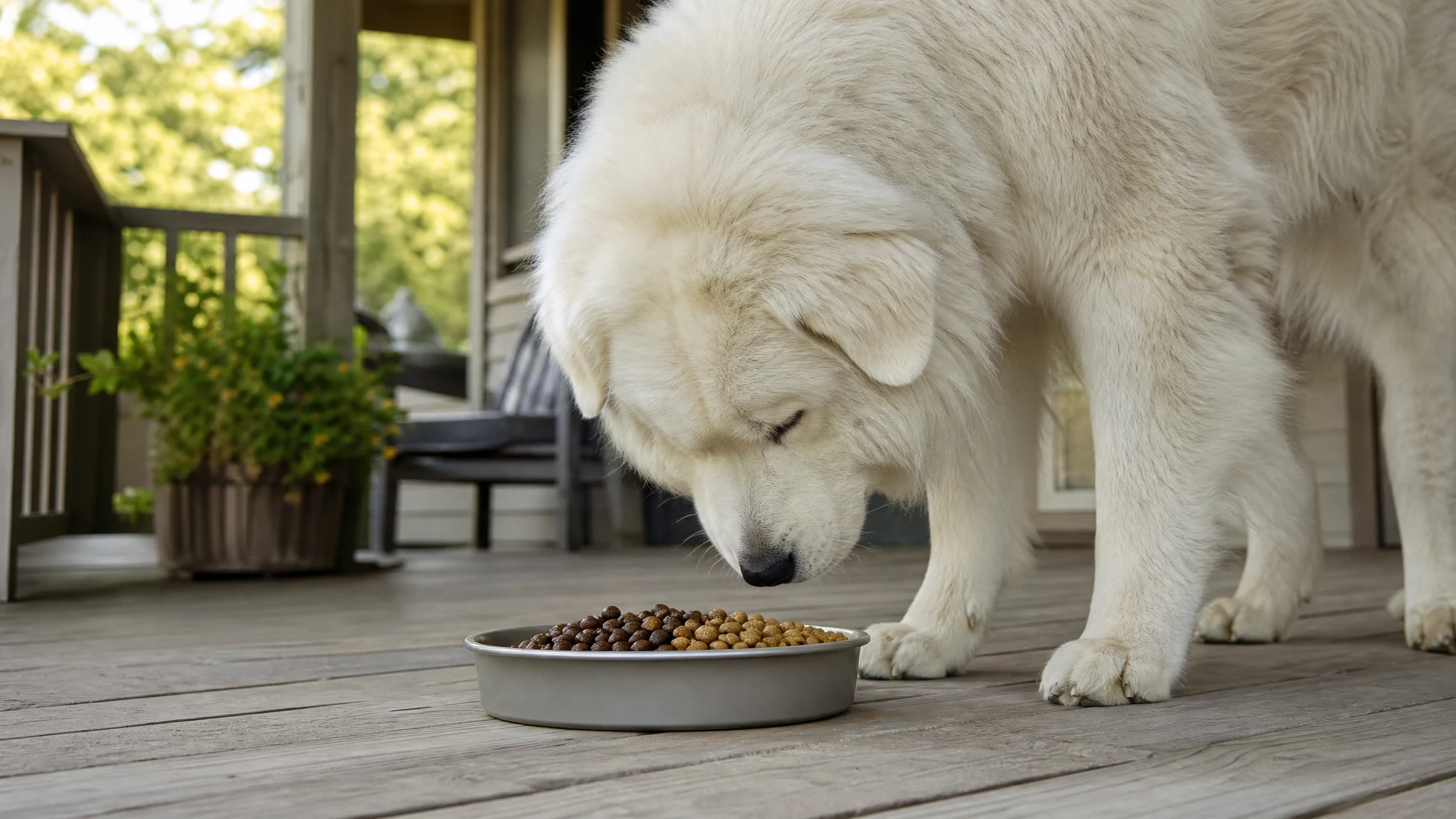
General nutrition information compiled from product labels and published sources, not veterinary advice. Your veterinarian is the right person to choose a diet for your dog, especially one with a health condition.
A Great Pyrenees can be a calm, steady eater one month and a puzzling one the next. Loose stools, gas or a sudden dislike of the bowl can make you wonder if the food is the problem.
This guide is a step-by-step way to notice the signs, rule out the urgent causes, and change foods carefully if your veterinarian agrees. It covers what to look for on a label when choosing dog food for gut health. It does not promise that any food will fix a problem.
Why this breed deserves a careful approach
The Westminster Kennel Club lists the Great Pyrenees as a large breed. Hill's Pet gives an adult weight of 85 to 120 pounds, with males heavier, and a life expectancy of 10 to 12 years. That is a lot of dog, so a small daily stomach upset can add up quickly in portion sizes and cleanup.
PetMD notes that bloat, also called GDV, is life-threatening in this breed. That is why sorting out which gut changes are urgent comes before any food experiment. For the wider picture, see our guide to the diet factors that matter for Great Pyrenees.
What you need before you start
- A notebook or phone note to log meals, treats, stools and energy.
- The current food's bag or can, so you can read the full label.
- A kitchen scale or a marked measuring cup, so portions stay the same.
- Your veterinarian's phone number, and the number of the nearest emergency clinic.
- Patience. A fair look at any food change takes weeks, not days.
Step 1: Know which signs are an emergency
Before you think about diet, separate the urgent from the ordinary. PetMD describes bloat (GDV) as life-threatening in the Great Pyrenees. It advises feeding several small meals, avoiding vigorous exercise around mealtimes and avoiding raised bowls. It also says a gastropexy is often done to help prevent GDV.
If your dog suddenly looks distressed after eating, has a tight or swollen belly, or tries to vomit and cannot, call a veterinarian or emergency clinic right away. Do not wait to see if a diet change helps.
Step 2: Watch for the ordinary signs of a food mismatch
These signs are common reasons owners start asking about food. None of them proves the diet is the cause, because many things can upset a dog's digestion. They are simply worth writing down:
- Stools that stay soft or loose over several days rather than one odd day.
- Frequent gas or a gurgling belly that is new for your dog.
- Occasional vomiting, or leaving meals untouched more often than usual.
- Itchy skin or ear trouble that appears alongside digestive changes.
- Weight drifting up or down without a change in portions.
Note the date, the food, any treats or table scraps, and what the stool looked like. A one-week log gives your veterinarian much better information than a memory.
Step 3: Check whether the life stage fits
A food can be fine on paper and wrong for the dog's age. Hill's says Great Pyrenees puppies need large-breed nutrition until at least 18 months, and that full adult size can take up to two years. It also says calcium and phosphorus ratios matter for bone development.
The Dog Food Advisor explains that growth and all-life-stages foods must state whether they include or exclude growth of large-size dogs, meaning dogs of 70 pounds or more as adults. A Great Pyrenees falls in that class. For a puppy, look for a label that says it includes growth of large-size dogs. If the wording is missing, ask the brand.
Step 4: Talk to your veterinarian first
Bring your log. Your veterinarian can check for parasites, food reactions and other medical causes, and can say whether a diet change makes sense for your individual dog.
Hill's lists Addison's disease as a concern in some lines, and PetMD says the breed generally does well on food formulated for large breeds, with diet best discussed with a vet. Neither source says a particular food treats a gut problem. Prescription diets are something only a veterinarian prescribes.
Step 5: Read labels the careful way
Marketing words such as "gentle" or "digestive" are not defined by the label rules. Read these parts instead:
- The AAFCO statement. It tells you the life stage the food is meant for, such as maintenance, growth or all life stages.
- The first five ingredients. They show what makes up most of the recipe by weight.
- The guaranteed analysis. Minimum protein and fat and maximum fiber are the guaranteed figures.
- Calories per cup. This lets you compare foods fairly and keep portions sensible.
Be aware that some brand pages show "dry matter" averages instead of guaranteed minimums. Those are not the same thing, so do not compare them against another bag's guaranteed analysis.
A label comparison of foods with large-breed wording
We compared label data from each brand's own page. We did not run feeding trials or taste tests, and we have not fed any of these foods to a dog. Kibble size was not listed on the pages we read, so check with the brand if it matters for your dog.
| Food | Stage | First ingredients | Calories |
|---|---|---|---|
| Hill's Science Diet Adult Sensitive Stomach & Skin Large Breed Chicken & Barley | Adult, large breed | Chicken, chicken meal, yellow peas, cracked pearled barley, brown rice | 393 kcal per cup |
| Hill's Science Diet Adult Large Breed Chicken & Barley | Adult, large breed | Chicken, cracked pearled barley, brown rice, brewers rice, whole grain wheat | 365 kcal per cup |
| Royal Canin Giant Adult Dry | Adult, over 100 lb | Chicken by-product meal, brewers rice, chicken fat, brown rice, corn protein meal | 427 kcal per cup |
| VICTOR Hi-Pro Plus Large Breed Puppy | All life stages | Chicken, chicken meal, brown rice, whole grain millet, whole grain sorghum | 365 kcal per cup |
Royal Canin lists 26% minimum protein, 18% minimum fat and 3.9% maximum fiber for its Giant Adult. VICTOR lists 30% minimum protein, 14% minimum fat and 6% maximum fiber. Hill's pages show dry matter averages only, so no guaranteed minimums were available to compare. The Hill's Sensitive Stomach & Skin page shows 25% protein and 1.5% fiber on a dry matter basis.
The names on these products describe what the brand intends. They are not a promise about your dog's digestion. Ask your veterinarian which one, if any, suits your dog.
Step 6: Change foods slowly
If your veterinarian agrees to a new food, avoid switching overnight. A gradual change is a common approach, and your vet can set the pace for your dog.
- Start with mostly the old food and a small share of the new one.
- Increase the new food in small steps over about a week or longer, as your veterinarian advises.
- Keep the total calories steady, using the calories per cup on each label.
- Hold treats and extras constant so the new food gets a fair test.
- Use the label's feeding guide as a starting point only, then adjust to body condition with your vet. Hill's says to adjust amounts as needed to maintain optimal weight.
Keep the feeding habits PetMD suggests for this breed: several small meals, no vigorous exercise around mealtimes and no raised bowls.
Tips that help
- Change one thing at a time. A new food plus new treats makes the cause impossible to find.
- Give the new food several weeks before judging it, unless your dog gets worse.
- Weigh or measure every meal. Large dogs gain weight quietly.
- Keep a short note on the stool and appetite for each day.
Common mistakes to avoid
- Switching foods every few days. It makes it hard to learn anything.
- Assuming grain-free is gentler. The FDA has investigated a possible link between certain diets and canine dilated cardiomyopathy. Its latest update is dated December 23, 2022, and it does not plan further public updates without meaningful new scientific information. Ask your veterinarian rather than guessing.
- Using a small-dog or general food for a puppy. Check the large-size growth wording.
- Ignoring emergency signs. Bloat is not a diet experiment.
- Adding supplements on your own. Ask your veterinarian first.
What results to expect
Some dogs may show firmer stools or fewer upset days after a well-chosen food change. Others may show no change, which can point to a cause that is not the food. Results vary from dog to dog, and no food is guaranteed to improve digestion.
If signs continue or get worse, go back to your veterinarian with your log. The information you collected will make that visit more useful.
Sources
- Westminster Kennel Club: Great Pyrenees breed page
- Hill's Pet: Great Pyrenees breed page
- PetMD: Great Pyrenees breed page
- Dog Food Advisor: AAFCO nutrient profiles
- FDA Center for Veterinary Medicine: diets and canine dilated cardiomyopathy
- Royal Canin: Giant Adult Dry
- Hill's Pet: Science Diet Adult Large Breed
- Hill's Pet: Science Diet Adult Sensitive Stomach & Skin Large Breed
- VICTOR Pet Food: Hi-Pro Plus Large Breed Puppy