What Makes a Dog Food Good for Gut Health: A Great Pyrenees Owner's Guide
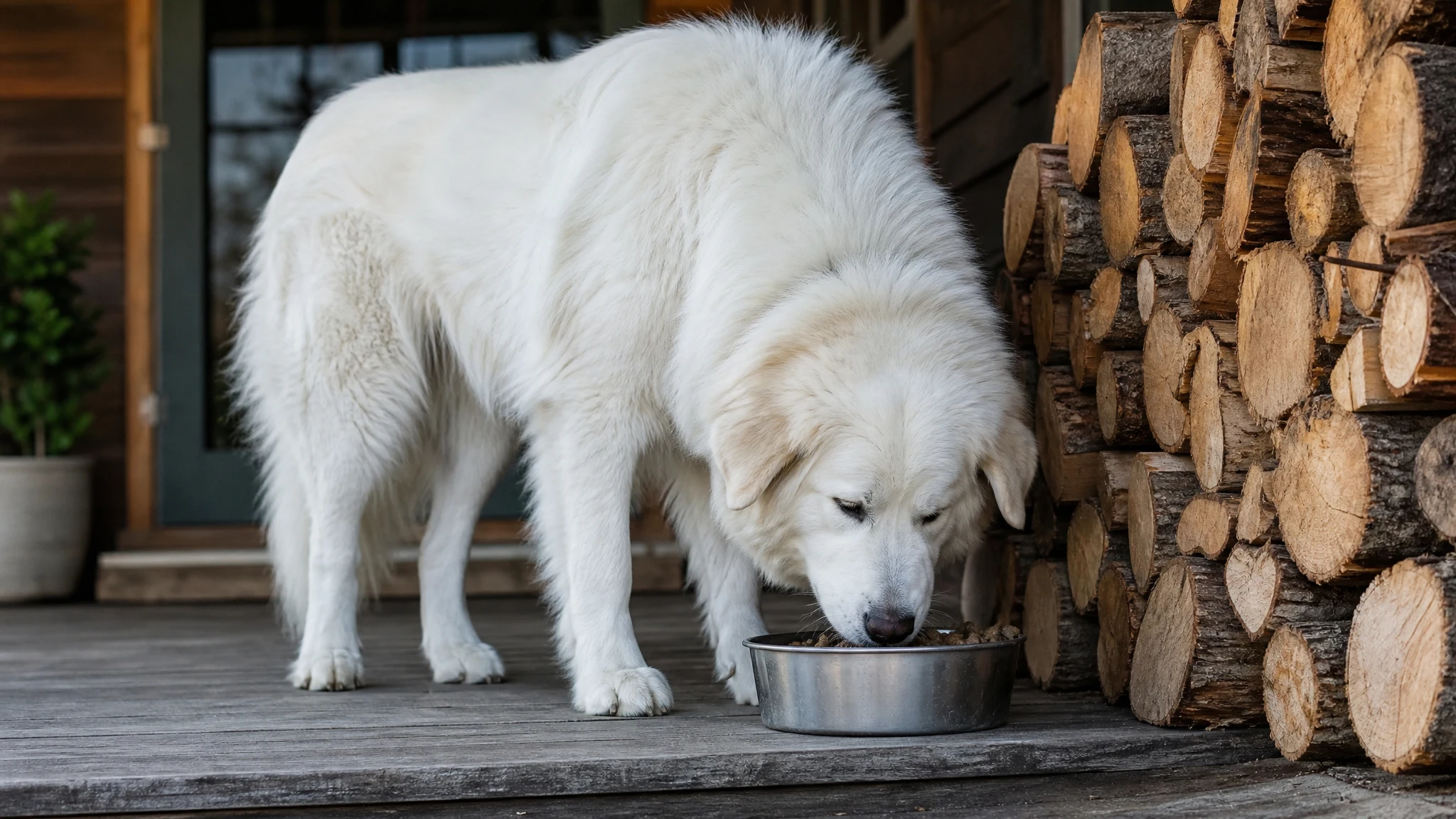
General nutrition information compiled from product labels and published sources, not veterinary advice. Your veterinarian is the right person to choose a diet for your dog, especially one with a health condition.
Most owners who want the best food for dog gut health end up staring at a wall of bags, each promising a happy stomach. Marketing words like "digestive support" are not the same as label facts.
This guide gives you a method for reading labels, comparing foods, and switching diets with a Great Pyrenees. It does not promise that any food will fix a digestive problem. A veterinarian decides what is right for an individual dog.
How we compared foods
We compared label data published by each brand on its own product page. We did not run feeding trials or taste tests, and we did not feed any of these foods to dogs. Where a brand page did not give a number, we say so and leave it blank.
Why the breed matters for gut-focused feeding
The Great Pyrenees is a large breed, according to the Westminster Kennel Club breed page. Hill's Pet lists adult weight at 85 to 120 pounds, with males heavier, and a life expectancy of 10 to 12 years.
Two breed points shape food choices:
- Bloat (GDV). PetMD calls it life-threatening in this breed. It advises multiple small meals, avoiding vigorous exercise around mealtimes, and avoiding raised bowls. PetMD also notes that a gastropexy is often done to help guard against GDV. Ask your veterinarian about all of this.
- Puppy growth. Hill's says Great Pyrenees puppies need large-breed nutrition until at least 18 months, and that calcium and phosphorus ratios matter for bone development. Full adult size can take up to two years.
For a wider look at diet factors in this breed, see Great Pyrenees nutrition and the diet factors that matter.
What you need before you start
- The bag, can or package of any food you are considering, or its brand product page.
- Your dog's current weight and age, from your veterinarian's scale if possible.
- A notebook or phone note for stool quality, appetite and energy.
- The name of any food you are currently feeding, with its feeding amount.
- A list of questions for your veterinarian.
Step-by-step: how to judge a food for gut health
Step 1: Match the life stage and size
Start with the nutritional adequacy statement, usually near the feeding directions. AAFCO growth and all-life-stages foods must say whether they include or exclude growth of large-size dogs (70 pounds or more as an adult), as explained by Dog Food Advisor. A Great Pyrenees falls in that class, so a puppy should eat a label that says "including growth of large-size dogs."
Adults can eat an adult maintenance food. Hill's lists its large-breed adult formulas for dogs 55 to 110 pounds, and Royal Canin has a giant adult formula for dogs over 100 pounds.
A food that matches your dog's stage is the base of any gut-friendly plan. Without that match, the other steps do not help.
Step 2: Read the first five ingredients
Ingredients are listed by weight. The first five show what the food is mostly built from. Look for a clear protein source, and notice what the carbohydrates are.
The label data shows real differences. VICTOR Hi-Pro Plus Large Breed Puppy starts with chicken, chicken meal, brown rice, whole grain millet and whole grain sorghum. Royal Canin Giant Adult starts with chicken by-product meal, brewers rice, chicken fat, brown rice and corn protein meal.
Neither list tells you how your dog will do. Ingredient lists show what is in the bag, not how your dog's gut will react. Treat them as a way to spot items your dog has reacted to before.
Step 3: Check fiber and calories
Fiber and calorie density affect stool and portion size. Here is what the brands publish. Hill's lists dry matter averages rather than guaranteed minimums, so we leave those cells without a number.
| Food | Label life stage | Fiber (max) | Calories per cup |
|---|---|---|---|
| Royal Canin Giant Adult Dry | Maintenance | 3.9% | 427 kcal ME |
| Royal Canin Large Adult Dry | Maintenance | 3.2% | 360 kcal ME |
| VICTOR Hi-Pro Plus Large Breed Puppy | All life stages | 6.0% | 365 kcal |
| Hill's Science Diet Adult Large Breed | Adult maintenance | Not given as a maximum | 365 kcal |
| Freshpet Large Dog Multi-Protein | Adult maintenance | 1% | 348 kcal |
A higher fiber number is not automatically better for gut health. Kibble size was not listed on any of these pages, so check with the brand if it matters for your dog.
Step 4: Look at the form of the food
Dry, wet and fresh foods all appear in the label data. Fresh options include Freshpet, Nom Nom and JustFoodForDogs.
JustFoodForDogs Beef & Russet Potato is adult maintenance and, per its page, is not intended for growing puppies. Nom Nom Beef Mash says it is formulated for all life stages, and its page relays that this includes growth of large-size dogs. Confirm the full statement on the brand page before feeding a puppy.
Fresh foods may suit some dogs, but a brand page cannot tell you whether it suits yours. Ask your veterinarian before changing to a fresh or home-style diet.
Step 5: Be careful with heart-related headlines
You may see worry about certain diets and dilated cardiomyopathy (DCM). The FDA Center for Veterinary Medicine's latest update on this topic is dated December 23, 2022. The FDA says it does not plan further public updates until there is meaningful new scientific information.
Read the FDA page yourself and bring questions to your veterinarian. Do not switch foods in a panic.
Step 6: Plan the switch slowly
Change foods gradually, mixing a little of the new food into the old and following the transition directions on the brand page or from your veterinarian. Abrupt changes are a common reason for loose stools, whatever the food.
Change one thing at a time. Do not add new treats or toppers during the switch.
Step 7: Start from the label guide, then adjust
Feeding amounts on bags are starting points. Hill's says to adjust amounts as necessary to maintain optimal weight. Royal Canin points to a calculator for its giant formulas, and its large adult page has a table by target weight and activity level.
For bloat-prone breeds, spreading the daily amount across smaller meals is the approach PetMD describes. Your veterinarian can set the plan for your dog.
Step 8: Track what you see
Write down stool quality, appetite, gas and energy for a few weeks. Notes help your veterinarian far more than "he seems fine." If a problem persists, get it checked.
Tips and common mistakes
- Chasing buzzwords. "Digestive," "sensitive" and "natural" are not defined by the label itself. Look at the adequacy statement and ingredient list instead.
- Feeding a general puppy food. The Hill's Puppy Chicken & Barley canned entree is not a large-breed formula, per its page. A large-breed puppy needs large-breed nutrition.
- Changing several things at once. You will not know what caused a change.
- Comparing guaranteed analysis to dry matter averages. They are measured differently, so do not compare them directly.
- Using a food as a treatment. Prescription diets are something only a veterinarian prescribes.
- Ignoring exercise timing. Per PetMD, avoid vigorous exercise around mealtimes.
What results to expect
A well-matched food, introduced slowly and fed in sensible amounts, may support steady digestion and consistent stools in some dogs. Results vary, and no food can be promised to resolve a digestive problem.
Hill's notes that hip and elbow dysplasia can occur in large dogs, and that controlled growth and moderate exercise support joints. PetMD says that exercise, weight and nutrition can influence these conditions. Food is one piece of a larger picture that includes your veterinarian's guidance.
Call your veterinarian promptly for repeated vomiting, a swollen or tight belly, unproductive retching, or a dog who seems to be in distress. These signs can point to an emergency.
The bottom line
The best food for dog gut health in a Great Pyrenees is the one that fits your dog's life stage and size, has a label you understand, and is fed in measured, steady meals. Start with a veterinarian conversation, then use the steps above to narrow your options.
Sources
- Westminster Kennel Club: Great Pyrenees breed page
- Hill's Pet: Great Pyrenees breed page
- PetMD: Great Pyrenees breed page
- FDA Center for Veterinary Medicine: diet and canine dilated cardiomyopathy
- Dog Food Advisor: AAFCO nutrient profiles
- Nom Nom: Beef Mash product page
- JustFoodForDogs: Beef & Russet Potato product page
- Hill's Science Diet: Puppy Chicken & Barley canned entree